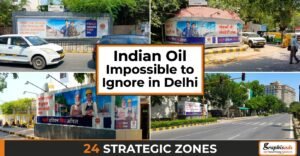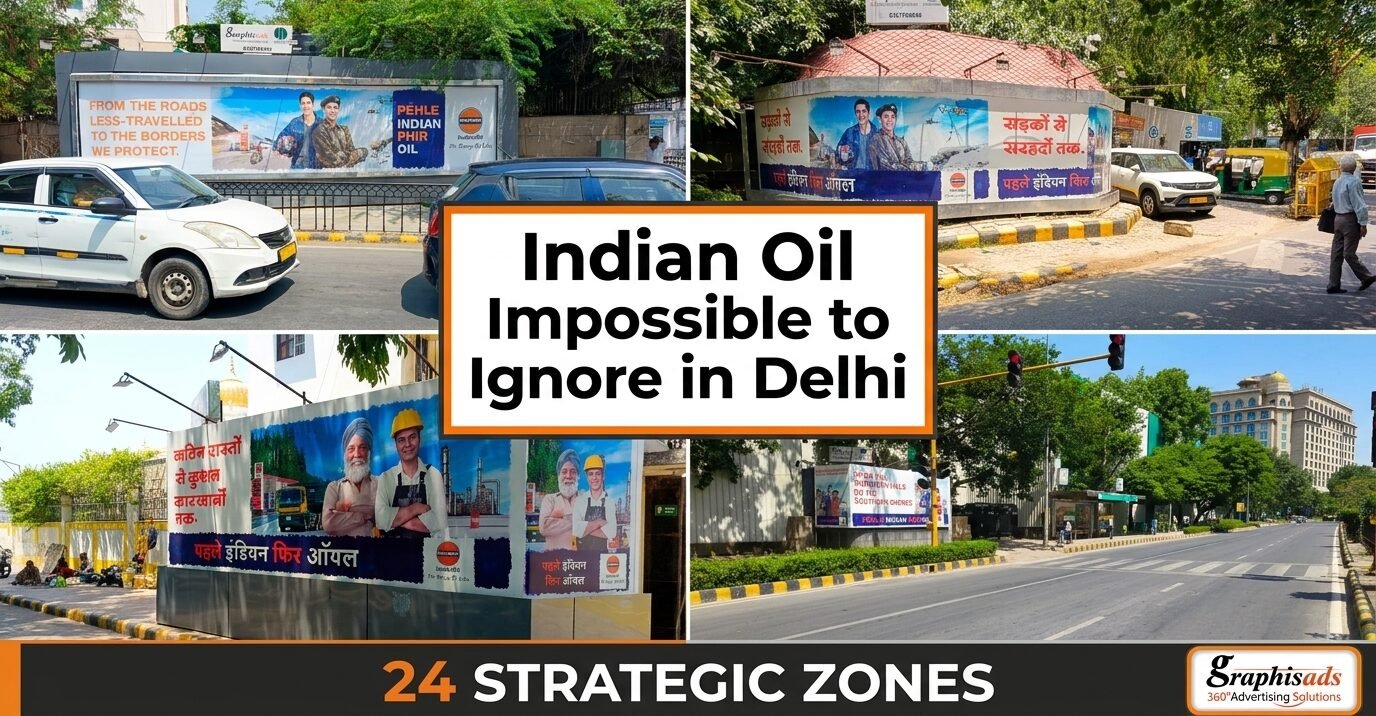
By partnering with the strategic urban branding experts at Graphisads, Indian Oil didn’t just scatter billboards across the capital. Instead, they executed a surgical, high-prestige takeover of Lutyens’ Delhi and its surrounding high-value zones. Using an exclusive network of premium NDMC Wall Panels, the campaign successfully wrapped the city’s highest-security power corridors in a powerful narrative of national identity.
1. The Strategy: Hyper-Targeted Proximity Over Mass Volume
The true brilliance of this campaign lies in its asset selection. Rather than fighting for attention on chaotic commercial highways, Graphisads targeted the precise geographic quadrants where India’s decision-makers, foreign diplomats, corporate leaders, legal minds, and premium consumers travel every single day.
By utilizing architecturally integrated street-level wall panels, the campaign captured premium audiences in spaces where traditional, massive hoardings are strictly prohibited due to city aesthetics and high-security protocols.
2. The Map of Influence: Connecting Delhi’s Elite Micro-Markets
To truly understand the scale of this execution, the 24 strategic zones occupied by Graphisads have been mapped and summarized by the specific human, professional, and commercial pulse they influence across the capital:
| Strategic Micro-Market Hub | Areas Covered & Key Geographic Landmarks | Core Audience Persona Targeted | Strategic Branding Objective |
| The Judicial & Administrative District | • Sher Shah Suri Marg (Opposite Delhi High Court)
• Tilak Marg (Patiala House Court Gate No. 1) • Purana Quila Road (Patiala House Court) • Sansad Marg (Near Akashwani Bhawan) • Gurudwara Rakab Ganj Road (North Block, Rakabganj) |
Senior advocates, sitting judges, ministry officials, policy-makers, and top-tier central bureaucrats. | Associates the brand with high-level institutional authority and trust. |
| The Diplomatic & Luxury Filter | • Africa Avenue (Near The Leela Palace)
• Niti Marg (Near Australian High Commission & Nehru Park) • Khan Market / Humayun Road belt |
International diplomats, global delegates, high-net-worth individuals (HNIs), and elite expatriates. | Embeds the corporate narrative within spaces of global prestige and affluent lifestyle. |
| VVIP Transit & High-Volume Corridors | • Sri Aurobindo Marg (Near Jor Bagh Metro Gates 1 & 3, AIIMS Hospital Gate 1, Safdarjung Hospital Gate 2, and Yusuf Sarai Market)
• Ring Road (Opposite World Trade Centre Sarojini Nagar & Hyatt Regency Bhikaji Cama Place) |
Daily corporate commuters, medical professionals, business owners, and cross-state transit travelers. | Delivers massive, uninterrupted volume metrics and frequency-driven brand recall. |
| Premium Commercial & Socio-Religious Hubs | • Connaught Place Outer Circle (Opposite LIC Building)
• Ashoka Road (Near Bangla Sahib Gurudwara & Janpath Lane) • Jai Singh Road (Opposite YMCA) • Bangla Sahib Road (Opposite Bangla Sweets) • Lodhi Colony Market (Outside Veer Savarkar Park) |
Financial sector executives, high-spending shoppers, urban tourists, and multi-income socio-religious transit crowds. | Aligns the brand message with an active, commercial, and highly engaged consumer mindset. |
3. Two Creative Narratives, One National Pulse
Graphisads carefully synchronized these physical locations with two distinct, deeply moving creative concepts, maximizing the psychological impact of the campaign:
- “From the Roads Less-Traveled to the Borders We Protect” (सड़कों से सरहदों तक): This visual narrative features IndianOil’s infrastructure supporting national defense forces in extreme terrains. Positioned strategically near diplomatic areas, high courts, and VVIP corridors, it elevated IndianOil from a commercial fuel provider to an indispensable pillar of national sovereignty.
- “From Tough Terrains to Efficient Refineries” (कठिन रास्तों से कुशल कारखानों तक): This creative honors the grit of the ground-level workforce, engineers, and state-of-the-art refineries driving the economy. Positioned across heavy commercial hubs like Connaught Place, Ring Road, and premium markets, it perfectly highlighted corporate excellence and industrial power.
4. The Campaign Impact: Why It Redefined Modern OOH
- 100% Visual Monopolization: Because the NDMC area strictly regulates outdoor clutter, the IndianOil panels experienced virtually zero visual competition. The brand owned the entire street-level narrative on every single stretch it occupied.
- Forced Dwell-Time Integration: Placed near traffic slow-downs, metro entries, hospital gates, and major intersections, the ads successfully turned waiting or walking times into deep brand engagement windows.
- Psychological Resonance: By physically embedding the message “Pehle Indian Phir Oil” into the very structures of our national capital’s administrative center, the slogan ceased to feel like a corporate tagline—it felt like an absolute national truth.
Conclusion: The Art of Corporate Sovereignty
The IndianOil deployment serves as an industry benchmark for executing a corporate image campaign with surgical, location-driven precision. Graphisads didn’t merely install signs; they mapped the human geography of New Delhi to give a legendary Indian brand the monumental, elite stage it deserved. It stands as definitive proof that when strategic geography aligns with a powerful corporate purpose, a brand does not just occupy space—it commands the capital.