Imagine your top-priority prospect—a CEO you’ve been chasing with LinkedIn ads for six months—stepping out of a taxi at an international airport.
They are drained. Their eyes are strained from a day of back-to-back video calls and a non-stop barrage of “thought leadership” posts in their mobile feed. Over the years, they’ve developed a military-grade “ad-blindness” to anything appearing on a glowing rectangle.
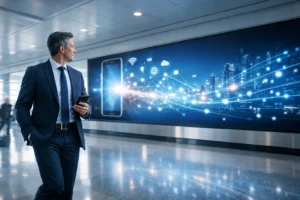
But as they head toward the terminal, they see it: a massive, crystal-clear digital display spanning the main entrance. It features a sharp, minimalist message from a service provider that solves their specific scalability headache.
They can’t scroll past it. They can’t “X” out. They can’t ignore it.
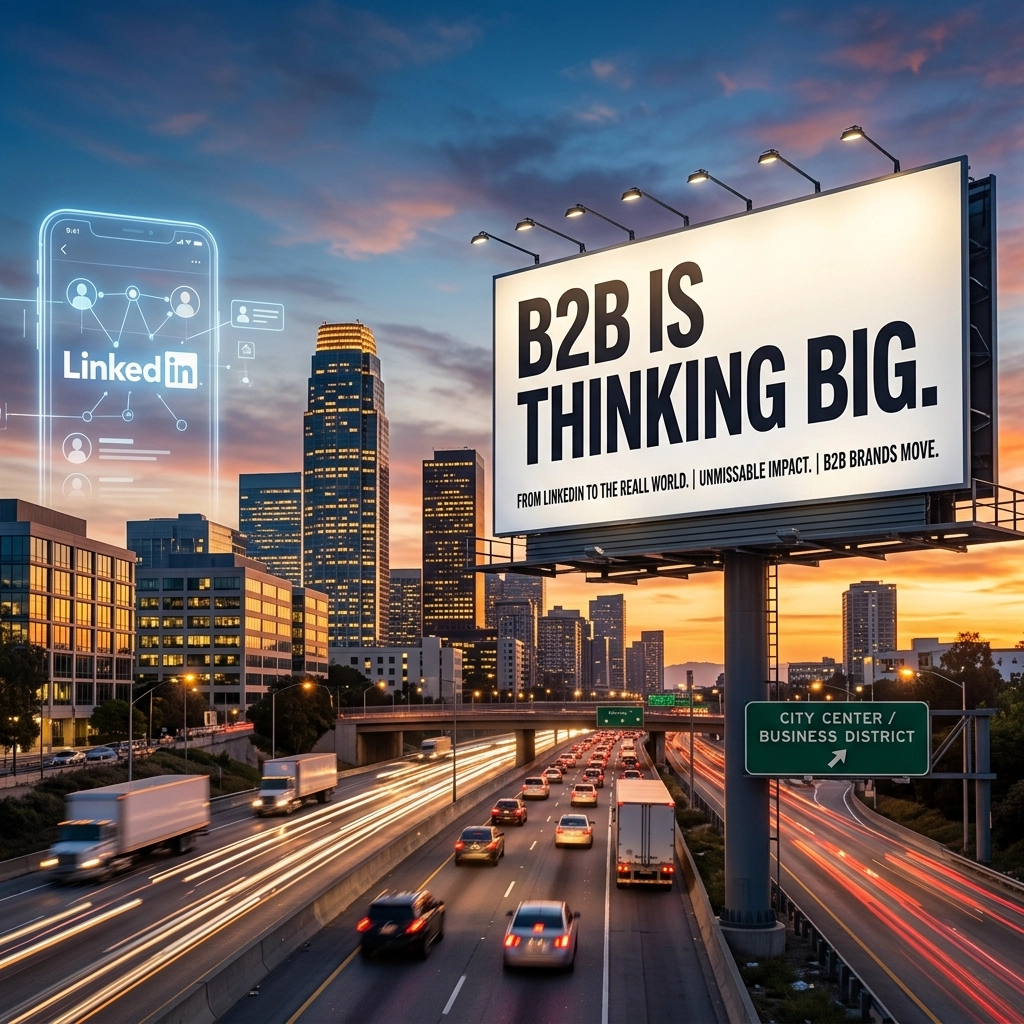
In 2026, this is the new reality. While LinkedIn is still a powerful networking tool, the most sophisticated B2B brands are diversifying. They are reclaiming the physical world to cut through the digital noise. In this guide, we’ll explore why B2B outdoor advertising is the new frontier for enterprise marketing strategies and how you can use it to own your niche.
What Exactly is B2B Outdoor Advertising?
For years, Out-of-Home (OOH) was considered a “B2C only” game—something for soft drinks and movie trailers. But in today’s environment, B2B outdoor advertising has become a precision instrument.
It involves the strategic placement of high-impact physical media—billboards, transit displays, and airport lounges—exactly where business decision-makers live and travel.
Unlike generic consumer campaigns, B2B OOH is hyper-targeted. It focuses on corporate parks, financial districts, and tech corridors. It’s about being present where the “9-to-5” (which is now a 24/7 cycle for executives) actually happens.
The Real Value: Why the Physical World Wins
The move from digital-only to a hybrid OOH approach isn’t a trend; it’s a direct response to digital saturation.
1. Curing Screen Fatigue
By the time a CTO or CMO finishes their day, they’ve filtered out hundreds of digital ads. Their brain is literally trained to ignore sponsored posts. B2B outdoor advertising offers a “mental reset” that actually gets registered. A physical brand presence commands an immediate sense of authority and permanence that a flickering digital ad can’t touch.
2. The Unskippable Advantage
You can’t install an ad-blocker on a highway. For Account-Based Marketing (ABM) specialists, OOH is the ultimate weapon. Imagine every employee of your target account seeing your brand on their commute to the office. That creates an internal buzz and “office talk” that a LinkedIn ad hidden in a private feed never will.
3. Scaling Your Brand Credibility
High-stakes B2B sales are built on trust. Seeing a brand on a massive “hoarding” or a premium airport display signals that the company is a major player. It suggests you have the stability and scale to handle their business.

2026 Trends: The New Era of B2B Media
The “old school” static billboard has been upgraded for the next chapter of integrated media.
-
Programmatic DOOH (pDOOH): You can now buy billboard space the same way you buy digital ads—using data to trigger your message only when your target audience is present. For B2B, this means “owning” the screens near a major industry summit only during the peak hours of attendance.
-
The Airport ROI: For executive targeting, the airport remains the “Cathedral of Commerce.” Decision-makers are often in a “captive” state here—waiting in lounges or at baggage claim. Airport advertising ROI is exceptionally high because the audience is pre-qualified; if they are in an international business lounge, they likely have the authority you’re looking for.
Roadmap: How to Move Your Budget to OOH
If you are a B2B Marketing Director looking to diversify, here is your media mix optimization plan:
-
Pinpoint Your Hubs: Don’t just spray and pray. Map out exactly where your target companies are based. Is it BKC in Mumbai, Cyber City in Gurgaon, or the tech parks of Bangalore?
-
Align with Event Calendars: Use OOH to “own” a city during a major trade show. Your brand should be the first thing prospects see when they land at the airport for a conference.
-
Simplify the Message: On social media, you have a caption. On a billboard, you have three seconds. Use a bold hook and one clear value prop.
-
The “Primer” Strategy: Use OOH to warm up your leads. Research shows people are much more likely to engage with your digital ads after they’ve seen your brand in the physical world.
Case Study: The ERP Takeover TechSaaS, an enterprise provider, shifted 40% of their digital budget into airport advertising at domestic terminals in Delhi and Mumbai. The Result: A 35% spike in branded searches and 22% higher LinkedIn CTRs. Most importantly, they closed four major contracts where the CEOs explicitly mentioned seeing the airport ads.
FAQs: What B2B Marketers Need to Know
-
Isn’t OOH too expensive for a startup? Not with programmatic DOOH. You can now buy tactical, data-driven placements for specific hours, making it far more accessible than the old 12-month leases.
-
How do we track success? We track branded search lift, vanity URLs, and the correlation between OOH presence and digital conversion rates in specific regions.
-
Is LinkedIn still relevant? Absolutely. LinkedIn is the closer, but OOH is the opener. Using them together creates the multi-touch environment needed to build trust.
Lead the Revolution
The “digital-only” era is evolving. As the internet gets louder and AI-generated content floods our feeds, the physical world is one of the last places where your brand can truly stand alone.
Don’t let your message get lost in the scroll. Elevate your presence and own the skyline.
At Graphisads, we’ve spent decades helping brands make an unmissable impact. From high-traffic airports to the most prestigious corporate corridors, we have the inventory to put you in front of the people who matter most.
Contact us today to explore our B2B OOH opportunities and start building larger-than-life authority.